
Your Forecasting AI doesn't know the half of it
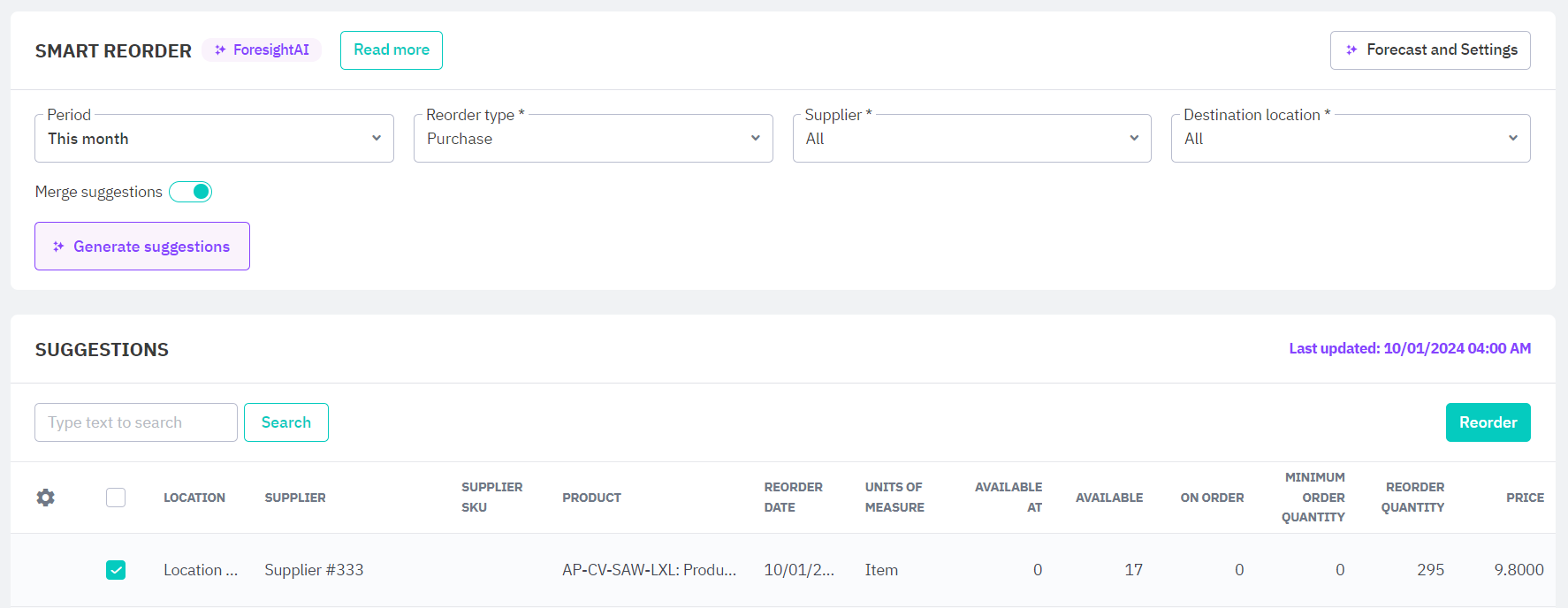
ForesightAI is one of the more genuinely useful things Cin7 Core has added in recent years. It looks at your sales history, lead times, and stock levels, tells you what to reorder, and when. Simple. Clear. Actionable.
And for a lot of businesses, that's enough most of the time.
But there's a problem. A fairly significant one that doesn't get talked about enough.
Before we jump in, it is worth noting that the limitation I'm about to describe applies to Inventory Planner, Stocktrim, and most other smart forecasting tools, too. We're only focusing on ForesightAI here because it's built into Cin7 Core, which is where our clients work.
Cin7 Core only knows what Cin7 Core knows.
ForesightAI isn't magic. It's algorithmic forecasting applied to your inventory data. And your inventory data, as good as it is, tells an incomplete story.
Cin7 Core has no idea what your cash position looks like. It doesn't know you've got a big tax bill due next month. It doesn't know you're waiting on a slow-paying customer to settle before you can place your next supplier order. It doesn't know your business has decided to pivot away from one product line and double down on another.
It just sees the numbers in front of it and makes a suggestion based on those numbers.
There is a Purchase Budget Planner inside ForesightAI. You can enter your available monthly spend, and the system will flag where you're heading for a shortfall and what that means for your margins. That's useful, as far as it goes. But it only knows what you tell it. It doesn't connect to your accounting system in real time, it can't see your upcoming liabilities, and it has no concept of anything that isn't a number.
Your warehouse team can't factor in what they don't know.
AI forecasting tools are designed to give your warehouse team real autonomy. Instead of waiting for a manager to approve every reorder, the right person can look at a clear, data-driven suggestion and act on it. Faster decisions, fewer bottlenecks, less stock running out at the wrong moment.
For day-to-day restocking, that's exactly what you want. The person closest to the warehouse making smart calls without needing a meeting about it.
But here's the thing. Your warehouse team, as good as they are, doesn't always know everything going on in the business. And as the business grows or goes through a big change, that gap widens. A major new customer. A cash crunch. A strategic shift. A supplier relationship that's about to change. None of that shows up in Cin7 Core, and your team can't factor in what they don't know.
And that's before you account for the stuff nobody can control. Shipping costs don't exist in a vacuum. Fuel prices move, carrier rates follow, and when a government somewhere decides to start a war in the Middle East, your freight bill has opinions about it whether you like it or not. ForesightAI isn't reading the news. It's looking at last quarter's numbers and making a reasonable call. Which is fine, until it isn't.
Somewhere in the building, someone is authorising and emailing the order. Somewhere else in the building, someone is staring at a spreadsheet thinking: I've got a bad feeling about this. By then, the order's already in.
Reordering big without the big picture.
Here's a scenario I see more often than you'd think.
ForesightAI tells you to reorder $10,000 worth of stock to meet projected demand. From a pure inventory standpoint, the suggestion is solid. Demand is there. Lead times say move now. The logic checks out.
Now add some context. That order is landing in the same week as a payroll run, a supplier payment, and a quarterly BAS (or an estimated tax payment if you're in the US). Your margins on that product line have been quietly eroding for two quarters. A competitor has just entered your market. And one of your bigger customers has gone oddly quiet in a way that makes you uneasy. ForesightAI sees none of that. It sees demand, lead time, and available stock. It says reorder.
Let's say that turns out to be wrong. Not catastrophically wrong, just wrong. That stock sits for three months rather than six weeks. At a carrying cost of roughly 25% per year, that's around $625 doing nothing. If you funded the order on a credit line, add interest on top. And if 20% of it ends up being written off because the product line gets wound back, you're looking at another $2,000.
In that scenario, a $10,000 reorder decision ends up costing you around $3,000 extra. Not because something catastrophic happened. Just because nobody had the full picture.
Now run that twice a year, across a product range that's slowly heading in the wrong direction. You're not just over-stocked. You're systematically eroding your margins every time you click reorder.
Where a specialist earns their keep.
This is the gap a supply chain specialist fills. Not by second-guessing ForesightAI, but by putting it in context.
The AI-generated suggestion is a useful starting point. A specialist takes it and runs it through a different set of questions. Does this order make sense for cashflow right now? Does it align with where the product range is heading? Is there a smarter structure, whether that's timing, volume, or the terms you go back to the supplier with?
That last one is worth expanding. A specialist who works across a portfolio of businesses, some of them significantly larger than yours, carries real weight with freight providers. They're not negotiating on behalf of one order. They're negotiating on behalf of all their clients at once, and providers know it. Better rates, smarter routing, and access to consolidation options most businesses wouldn't get anywhere near on their own.
The answer to the reorder question might be: yes, do exactly what ForesightAI says. Or: do it, but split the order and ship it in two tranches. Or: hold off entirely, and here's specifically why. That last answer is the hardest one to hear when a system is confidently telling you otherwise. It's also, sometimes, the right one.
That kind of call doesn't come from software. It comes from working across a lot of businesses, in a lot of situations, over a long time. And it's the difference between a reorder decision and a good reorder decision.
Tools are only as good as the context around them.
I'm not trying to talk down ForesightAI. It's a solid tool and I'd rather clients have it than not. But tools work best when someone with the full picture is sitting behind them.
The cashflow and tax decisions in all of this sit with you and your accountant, not us. Our lane is the inventory and supply chain layer. And from where we sit, the businesses that get the most out of ForesightAI aren't the ones who follow every suggestion. They're the ones who use it as a starting point and apply judgment on top.
If you're using ForesightAI to drive your restocking and nothing else is feeding into those decisions, you might be optimising your inventory at the expense of your business. And that's a fairly expensive kind of optimisation.
If you want to talk through how to get more out of your forecasting setup, and make sure your reorder decisions are working for the whole business and not just the warehouse, get in touch.
The short version.
ForesightAI is a solid tool and you should use it. But it only knows what Cin7 Core knows, and that's never the whole picture. Your cashflow position, your strategic direction, your upcoming liabilities, the market shift you spotted last week: none of that shows up in a reorder suggestion. The software makes a good call based on inventory data. Whether it's the right call for your business is a different question, and it needs a human to answer it.